
What Does It Mean That the Body Holds Trauma? This Is How I See It

Updated: Apr 21
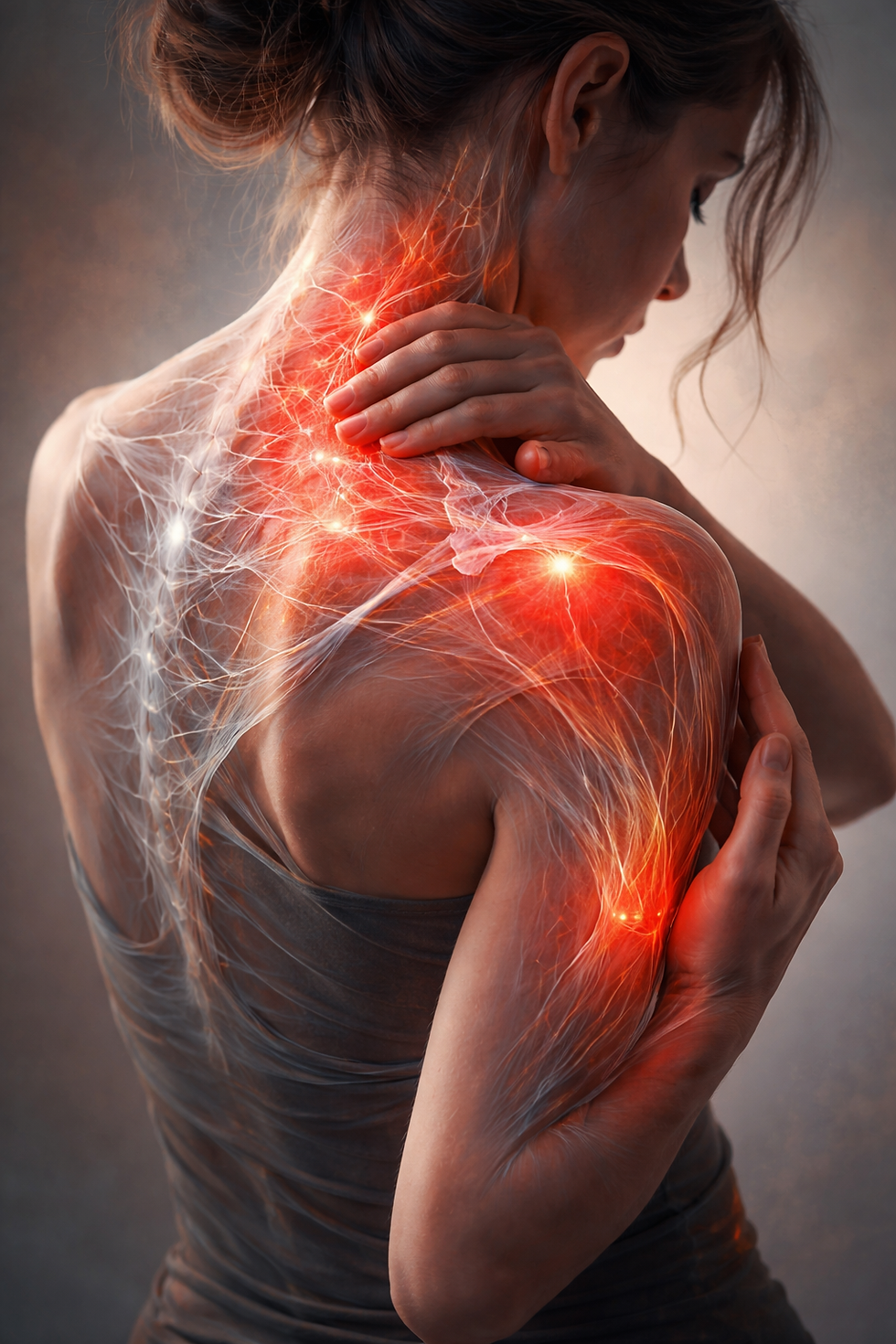
In my work, I meet people from many different backgrounds, and again and again I see something that becomes impossible to ignore: many forms of emotional suffering do not live only in thoughts. They also live in the body — in tension, in breathing patterns, in contraction, in hypersensitivity, in emotional reactions, in the way the nervous system responds, and in the way a person continues to carry something long after the original experience has passed.
So when I use the word trauma here, I am not using it as a formal clinical diagnosis. I am using it in the broad sense in which I understand it: as the lasting imprint of overwhelming, painful, destabilizing, or emotionally intense experiences that continue to echo in the body, the mind, and the emotional world of the person. Trauma, in this sense, can often be recognized in those moments when something in us reacts with more intensity than the present situation seems to justify — as if the body were still remembering something the conscious mind may not fully see.
From this view, what people often call trauma in the body is not a memory stored like an object inside a muscle. It is a way the body learned to organize itself around pain, protection, fear, vigilance, survival, and emotional holding. It is information, patterning, and learned response moving through one connected system.
The nervous system perceives, interprets, and organizes. The muscles respond. The breath responds. The fascia responds. Posture, voice, facial expression — all respond. When I say the body holds trauma, what I mean is that the body expresses it: through reaction, bracing, contraction, emotional charge, hypersensitivity, and protective reflex.
The Body Remembers What the Mind May Have Already Explained
A person can talk about something for years. They can understand it intellectually, place it in context, even forgive it. And still, their shoulders rise when a certain tone enters someone's voice. Their stomach tightens before they know why. Their chest closes in a room that should feel safe. Their jaw hardens during a conversation that seems, on the surface, harmless.
This does not mean the person is weak, irrational, or broken. It means something in them learned. Something in them adapted. Something in them is still responding from a place that once felt necessary.
The body is not remembering in words. It is remembering in sensation, in posture, in speed of activation, in emotional charge, and in patterns that may have been repeated so many times they no longer feel like patterns. They just feel like "me."
That is one of the most important things to understand. Sometimes what we call personality, sensitivity, reactivity, overthinking, shutdown, or exhaustion may also be a body that learned to organize itself around what it has lived.
The Intelligence of the Survival Response
The survival response itself is not the problem. When something feels too intense, too threatening, too painful, or too overwhelming for the system, the body responds: muscles activate, breath changes, attention narrows, heart rate increases, the entire being moves into protection. There is great intelligence in this. The body is trying to help us survive.
The nervous system is central here. It is constantly receiving information, interpreting what feels safe or unsafe, and directing responses throughout the whole body. It is not separate from the emotional life of the person. It is one of the main ways emotional life becomes physical.
If the nervous system perceives threat — whether physical, emotional, relational, or remembered — the body responds as a whole. Muscles tighten, fascia participates, breath shortens, the throat guards itself. The body prepares.
What seems important to me is not that this response appears, but that sometimes it does not fully resolve. Sometimes the body activates but does not complete. Sometimes the person had no real space to cry, shake, rage, run, speak, collapse, or process what was happening. Sometimes the experience was not one dramatic event, but something subtle, repeated, relational, cumulative — something that kept happening, something that had to be endured.
When this happens, the nervous system may continue carrying the response forward, and the rest of the body keeps participating in it.What was once protection becomes pattern.
A person may then live for years with chronic tension, fatigue, shallow breathing, digestive reactions, a guarded chest, a tight throat, chronic over-vigilance, emotional flooding, or a body that always seems to be preparing for something. Sometimes they call it stress. Sometimes anxiety. Sometimes just "how I am."
But very often, what is living there is an old form of protection that never fully learned it was safe to let go.
Not All Physical Pain Is Emotional — But the Body and Emotions Are Not Separate
Not every pain in the body comes from emotional history. Bodies also hurt because of inflammation, posture, overuse, lack of rest, mechanical strain, hormonal shifts, old injuries, and many other very real factors.
But I do not see the body as separate from the emotional life of the person living inside it. If the nervous system has learned to live in chronic defense, that does not remain only in thought. A jaw that keeps clenching may begin to hurt. A neck that keeps guarding may become chronically tight. A back that is always bracing may begin to ache. The breath may remain shallow.
I say this carefully, because I do not want to reduce every illness or every symptom to emotion. But the way a person lives internally can shape the way the body functions over time. This is also why, when I accompany someone, I cannot look only at one layer. A person's relationship to movement, to rest, to how they speak to themselves, the things they avoid and the things they keep repeating — all of this can be part of the same larger organization.
Fascia, Posture, and the Shape of Emotional Holding
Fascia is the connective tissue that surrounds, supports, wraps, and interconnects everything inside the body. Muscles, organs, bones, nerves, and blood vessels are not sitting there separately — they are held within a continuous web of living tissue. This matters because fascia is not passive packing material. It is living, responsive tissue. It reacts to movement, stress, tension, posture, and repeated patterns of use, and it is in ongoing communication with the nervous system.
If someone has lived for years in fear, suppression, vigilance, grief, or the pressure to hold everything together, this does not only affect thoughts. It can gradually affect the way the whole body organizes itself. The chest may stay somewhat closed. The diaphragm may move less freely. The jaw may harden. The throat may remain guarded. The belly may tighten. The spine and posture may begin adapting around these internal states.
Fascia participates in the shape the body takes over time. It helps transmit tension and links one region to another. A person may feel pain in the neck without realizing the holding is connected to the jaw, the chest, the breath, the belly — a more global pattern of contraction.
This is also why body-based awareness can be so powerful. When a person begins to notice their posture, their breath, the areas that seem dense, numb, tight, or disconnected, they are beginning to notice the lived organization of the body itself.
Emotions Are Not Only Mental
Emotions are felt in the whole being. We do not only think sadness — we feel it in the chest, the throat, the face, the breath, the belly, the eyes. We do not only think fear — we feel it in the heart rate, in the stomach, in the skin, in the limbs. We do not only think shame — we feel it in posture, in collapse, in heat, in the impulse to disappear.
If emotions are lived through the whole body, then emotions that could not be fully felt, expressed, or completed may also continue to echo through the whole body.
A grief that was never fully cried.
A rage that was never safe to express.
A fear that had nowhere to go.
A chronic pressure to be good, to perform, to endure, to stay calm, to not burden others, to not fall apart.
These things do not simply vanish because time passes. They can remain as unfinished internal movements. As contractions. As open loops. As energy still organizing the person from underneath.
This is why the body can respond in ways the mind does not fully understand. A person may think: Why did I react like that? Why did my throat close? Why did I smile when I did not want to smile? Why do I know something is not good for me and still move toward it?
These are deeply human questions. And often the mind is genuinely confused, because the response is happening faster and deeper than conscious reasoning. The nervous system is already interpreting, the body is already reacting, the old information is already moving through breath, muscle tone, fascia, and emotional charge before the mind has caught up.
A person can understand very well where something comes from and still feel their body continuing to obey it. This is why the body is so important in healing — because sometimes it is still speaking the emotion long after the person has stopped consciously narrating it.
What We Inherit, What We Learn, What We Carry
Not everything we carry began with us personally.
If you look at families across generations, sometimes there is something unmistakable that moves through them — not only in beliefs or behaviors, but in the body itself. A way of holding the face. A way of tightening under pressure. A way of going silent. A way of bracing. A way of waiting for something to go wrong. A way of not resting even when there is no immediate threat.
Some of this may be relational learning. Some energetic. Some modeled through years of proximity. Some may have biological and intergenerational dimensions. I say this carefully, because I do not want to make rigid claims where mystery still exists. But many of us arrive already inside nervous systems, family systems, and emotional atmospheres that shape us before we have words for what is happening.
And because it has always been there, it can feel invisible. It can feel simply like "who we are."
Why Awareness Changes So Much
The same body that carries these patterns is also the doorway through which change can begin.
The body is not only where pain is held. It is also where truth is revealed, where awareness becomes real, where patterns become visible. Where a person can begin to notice: my breath changes here. My neck tightens here. My jaw hardens here. My voice changes here. My body prepares here.
These moments of noticing are not small. To me, they are sacred — because something begins to separate. The person is no longer completely fused with the pattern. There is now an observing presence. There is now space.
And often, healing begins there. Not necessarily with immediate release or dramatic catharsis. But with awareness. With honest noticing. With slowing down enough to sense what the body has been doing on our behalf all this time.
This is one reason my work is not only conversational. Conversation matters, because words help bring light, meaning, recognition, and coherence. But alongside that, I am also listening for the body — for where the person speeds up, contracts, disconnects, hardens, loses breath, loses presence, or becomes overwhelmed. Because very often the body is telling the truth before the words fully arrive.
Liberation Is Not Forcing the Body to Let Go
My way of approaching healing is holistic, spiritual, energetic, and somatic. When I accompany someone, I am not only listening to what happened. I am also paying attention to how it lives in them now: in the breath, in the tone of voice, in posture, in what seems activated, absent, frozen, or ready to soften. Sometimes healing begins through words, through being deeply heard. Sometimes through body awareness, grounding, silence, spiritual connection, prayer, presence, or energy work.
But I do not think real healing comes from attacking the body or forcing it to release before it is ready. The body has reasons for what it is doing. Even its tension has intelligence. Even its armoring has meaning.
Liberation, as I understand it, is not about violently removing something bad from the self. It is about creating enough awareness, enough safety, enough honesty, and enough support that the body no longer has to organize itself in the same old way. That may look very quiet.
A deeper breath. A softer belly. A throat that opens a little more. A conversation that no longer creates the same internal collapse. A nervous system that reacts with less intensity. A person who notices, for the first time, that what they thought was simply their personality was also a pattern of protection. To me, that is profound healing.
You Are Not Broken
Much of what we call dysfunction is, very often, adaptation.
The tension was once protection.
The shutdown was once protection.
The hypervigilance was once protection.
The emotional flooding was once protection.
The guardedness was once protection.
Even what was inherited may have once been part of survival.
This does not mean we must remain inside those patterns forever. But it does mean we can approach them with more respect, more compassion, and more wisdom. The body is not the enemy. The body has been trying to help.
And when we begin to listen with presence instead of domination, with curiosity instead of judgment, with patience instead of force, something new becomes possible. The body can begin to learn that it does not have to carry everything in the same way anymore. It can learn safety. It can learn rest. It can learn another shape, another breath, another way of being.
Final Note
I am not a psychologist or a psychotherapist. Everything I have written here comes from my own understanding and from the way I observe and accompany people in my work. This is not meant as a clinical definition, but as a spiritual, somatic, energetic, and human way of understanding why emotional suffering can continue to live in the body, in the nervous system, in the emotions, and in the patterns through which a person experiences life.
Katiana
This article is inspired in part by broader somatic and trauma-informed conversations, including ideas associated with Peter Levine, Bessel van der Kolk, Candace Pert, fascia research, and intergenerational trauma studies, while expressing my own personal understanding and way of working.


Comments